
Basis for preparation
BP1
This sustainability statement has been prepared in voluntary alignment with the Corporate Sustainability Reporting Directive (CSRD), as established under Article 29(a) of EU Directive 2013/34/EU, and the associated European Sustainability Reporting Standards (ESRS).
As a Group registered within the European Union and meeting the relevant eligibility thresholds, Gunvor was initially subject to mandatory ESRS reporting. Following the 2025 Omnibus legislative update, this obligation has been deferred by two years, with first mandatory reporting now expected in 2028 for the financial year of 2027. Nonetheless, Gunvor has elected to voluntarily align its sustainability disclosures with the CSRD/ESRS framework ahead of that deadline, reflecting its commitment to transparency and proactive governance.
The statement covers material sustainability topics across our value chain, encompassing identified impacts, risks and opportunities (IROs) as well as matters of broader strategic relevance. The general disclosures address governance responsibilities, sustainability due diligence, risk management, business model and strategy, stakeholder engagement, and outcomes of the Double Materiality Assessment (DMA).
The statement is prepared on a consolidated basis, consistent with the scope of Gunvor’s financial statements for the period 1 January to 31 December 2025. It encompasses the parent Company and all directly and indirectly controlled subsidiaries. Unless stated otherwise, all policies apply to every Gunvor entity, employee, and individual operating under Gunvor’s operational control, defined as any entity over which Gunvor or a subsidiary exercises full authority to implement Group-wide policies.
Disclosures in relation to specific circumstances:
Time horizon: We have considered the time horizons as defined in ESRS 1 par. 6.4, where short-term is the reporting period in the financial statements (0–1 years). Medium-term covers the period from the end of the short-term reporting period up to 5 years, and long-term refers to anything more than 5 years (2030 onwards).
Use of estimates: To minimise risks of reporting errors or misinformation with regard to its ESG performance, Gunvor has put in place clear checks and balances. Everyone uses the same templates, follows agreed review steps, and has a designated person responsible for each data area. These team members regularly double-check the information before it’s shared.
External review: In preparation for CSRD compliance, Gunvor’s external Group auditor (KPMG) has performed a non-assurance advisory review on a selection of sustainability indicators, namely GHG Scope 3 emissions, Air pollution, Health & Safety indicators, and Human Capital KPIs. The current sustainability report is not subject to limited assurance. Gunvor is preparing to undergo limited assurance at the point of mandatory reporting and will continue to strengthen its data, systems and controls to meet more stringent assurance requirements in future years.
Changes in reporting: The reporting has been significantly expanded on sustainability disclosures to align with the CSRD and ESRS requirements, which is expected to become mandatory for the Company in the near future.
The role of the administrative, management and supervisory bodies:
Gunvor has established a robust governance framework to ensure accountability, transparency, and ethical business conduct across all organizational levels. In 2025, Gunvor underwent a Management Buy-Out. Over the years, the Company has evolved from being a founder-led, regional trader to becoming a fully employee-owned, global commodities trading company. Our Leadership and Governance structures reflect the partnership model and have been designed to ensure the effective delegation of authority and responsibilities across business areas and geographies while upholding efficient decision making.
The Board of Directors ensures that the CEO and management operate within the guidelines of the partners, e.g. in terms of risk-taking, investments and material business decisions. Two distinct committees, the Trading Committee and the Corporate Committee, replaced the former Executive Committee, overseeing trading and corporate matters respectively.
Robust Risk and Compliance controls serve to support these activities, along with Gunvor’s long-term global growth, development, and diversification strategy. An independent Audit Committee and Internal Audit Department report to the Board of Directors. Also reporting to the Board of Directors is the Remuneration Committee, whose role is to manage the various aspects of compensation policies and strategic hirings, and the Compliance Committee responsible for enforcing strict controls, including but not limited to ABC, sanctions, and KYC.
These committees help the Board maintain a clear focus on delivering strong, sustainable performance with integrity whilst safeguarding compliance with regulatory standards and upholding corporate values in business decision-making processes.
In line with Gunvor’s continuing efforts to improve governance practices, the Board formally reviews all major strategic and risk decisions, including the Company’s approach to sustainability and compliance. It oversees the Group’s commitments to transparent reporting, adherence to international regulatory frameworks, and robust compliance with relevant laws and regulations in the places we operate.
Role of the Group Compliance Committee
Gunvor’s governance structure is anchored in the Group Compliance Committee (GCC), which has steadily expanded its role since it was initially set up in 2015. The GCC has formal authority to review and challenge all material compliance-related matters and is empowered with veto rights on critical business decisions. The GCC is composed of key senior executives from the Group’s legal, financial, and operational functions, ensuring representation of critical expertise and clear lines of accountability:
- Voting Members: Chief Legal Officer, Chief Financial Officer, Chief Operating Officer, and Global Head of Ethics & Sustainability.
- Non-Voting Advisors: Senior advisors covering trading, internal audit, trading compliance, and other specialized topics.
The GCC convenes regularly to oversee the development and implementation of Gunvor’s compliance and ethics strategies. It also reviews potential new legislation or regulations, guides the management of any compliance breaches, and examines root causes to prevent recurrence. By bringing together multiple areas of expertise, the GCC ensures that compliance considerations are embedded within broader operational and commercial decisions.
The GCC reports directly to Gunvor’s Board of Directors on key risk areas and material compliance issues. This structured approach enhances transparency and ensures that significant matters receive the highest level of attention.
Compliance Expertise in Leadership
In 2025 Gunvor’s Compliance Department has expanded to a global footprint of 44 professionals, distributed across core operational hubs:
Compliance organisation chart
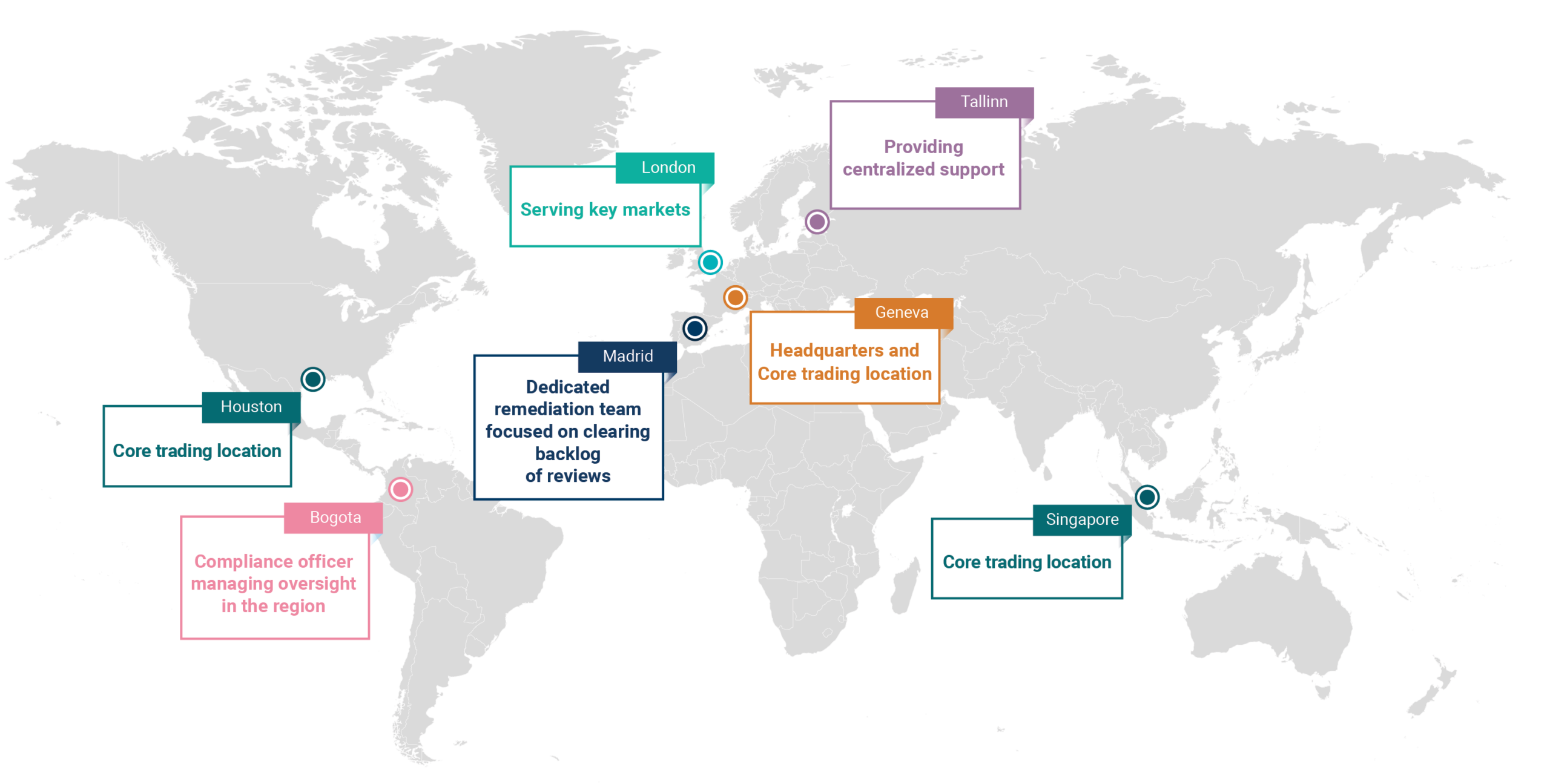
This expansion facilitates localized expertise, timely risk mitigation, and comprehensive compliance coverage. Reflecting Gunvor’s deep focus on compliance, the team continues to review processes, oversee policy adherence, and identify new risk areas posed by complex international regulations.
Information provided to bodies:
Gunvor’s committees are regularly updated and informed on respective sustainability topics. The Group’s Health, Safety, Environment, Human Rights & Communities (HSEC) Committee is the governance body at a corporate level for identifying and managing operational, safety, health, environmental, human rights and community risks across our operations. It is chaired by Gunvor Group’s Chief Operating Officer (COO) and includes members in finance, legal, HR, the Technical Director and the Global Head of Ethics and Sustainability.
Members of our HSEC Committee form a separate subcommittee for the operational sites called the Assets HSEC Committee, responsible for overseeing operational and environmental matters. This subcommittee is frequently briefed on Gunvor’s material impacts, risks and opportunities as part of monthly internal CSRD updates. The updates include correspondence regarding DMA matters, data validation results, as well as outlined impacts, risks and opportunities (IROs) across Gunvor’s activities.
This two-way structure ensures that issues are prioritised and addressed effectively at both corporate and asset (operational) levels, in alignment with our broader strategy, risk and performance management policies across the Company.
Integration of sustainability- related performance in incentive schemes:
The remuneration policy for executive members is designed to align with Gunvor’s strategic priorities and long-term value creation. While the remuneration policy does not currently include specific sustainability-related key performance indicators (KPIs), Gunvor will be assessing how to integrate these sustainability considerations into its broader management incentive plan.
GOV-5Risk management and internal controls:
Gunvor has established a structured risk management framework that includes the identification, quantitative assessment, and management of sustainability-related risks. These risks are integrated into the broader corporate risk management functions and are reviewed periodically by the HSEC committee. Key sustainability risks considered include regulatory compliance, climate-related financial risks, social risks and reputational risks as part of sustainability reporting. Risk assessments are conducted on an ad hoc basis through internal audits of our operating assets, stakeholder engagement, and internal consultations to ensure alignment with regulatory requirements.
In light of the upcoming CSRD reporting, Gunvor has expanded its internal control systems and is currently in the process of developing a new CSRD data management system which will benefit data accuracy and data validation processes whilst preparing for an increased scope of reporting as per the ESRS. Given the variety of data required to be collected as per the CSRD, the system will act as the backbone of the Group’s dataflows and will aim to provide an ongoing evaluation of risks concerning data accuracy and completeness.
As a fully integrated risk management department within Gunvor, the Compliance team operates a Counterparty Management System (CMS) that acts as the centrepiece of Gunvor’s third party management controls, allowing it to identify and manage compliance risks in a timely and effective manner.
SBM-1Strategy, Business Model and Value Chain:
Strategy
Gunvor transports physical energy from where it is sourced and stored to where demand is highest, leveraging the most logistically efficient modes – ships, rail, trucks, and pipelines. While its roots are in oil trading, While its roots are in oil trading, Gunvor has evolved to trade a broader mix of commodities in line with market demand. In 2025, energy products (biofuels, natural gas, and LNG) represented around one-third of the Company’s total trading volume. The metals business has also continued to grow over the past two years and now represents a meaningful part of the portfolio.
Looking ahead, what Gunvor trades will reflect the global balancing act between affordable energy, economic growth, and the urgent need to reach net-zero emissions in response to climate change. Emerging opportunities lie in hydrogen, ammonia, and solar.
The Company’s growth over the past two decades to become one of the world’s largest independent energy traders stems from its agility and entrepreneurial mindset. Gunvor relies on advanced analytics for rapid decision-making, uphold strong governance and Compliance standards to manage risk, and harness digitization and AI to gain a competitive edge.
Gunvor also fosters a culture of openness, collaboration, and innovation. We empower our people to challenge ideas, contribute new solutions, and continuously drive improvement. As a global energy trader, we see significant opportunities ahead to grow, diversify, and lead the Energy Transition.
Value Chain
Gunvor’s own operations comprise different entities, joint operations, and joint ventures across the value chain. For the purpose of the ESRS disclosures and a more accurate understanding of the related impacts, risks and opportunities that arise from our material topics, we have segmented our value chain into upstream, midstream and downstream operations.
The upstream activities, such as product sourcing, span over a diversified global supply base to secure crude oil, refined products, LNG, natural gas, biofuels, and other commodities.
The midstream activities, including logistics and shipping, are leveraged to ensure transportation of our products in an efficient and timely manner across the Group’s network. Another part of its midstream operations constitutes asset ownership and strategic investments in critical infrastructure, such as refineries, biofuel plants, storage terminals and pipelines that can be used to further refine and transport our products and meet client demand. As Gunvor’s presence across physical assets is growing, it remains committed to navigating sustainability disclosures in alignment with the growing regulatory landscape.
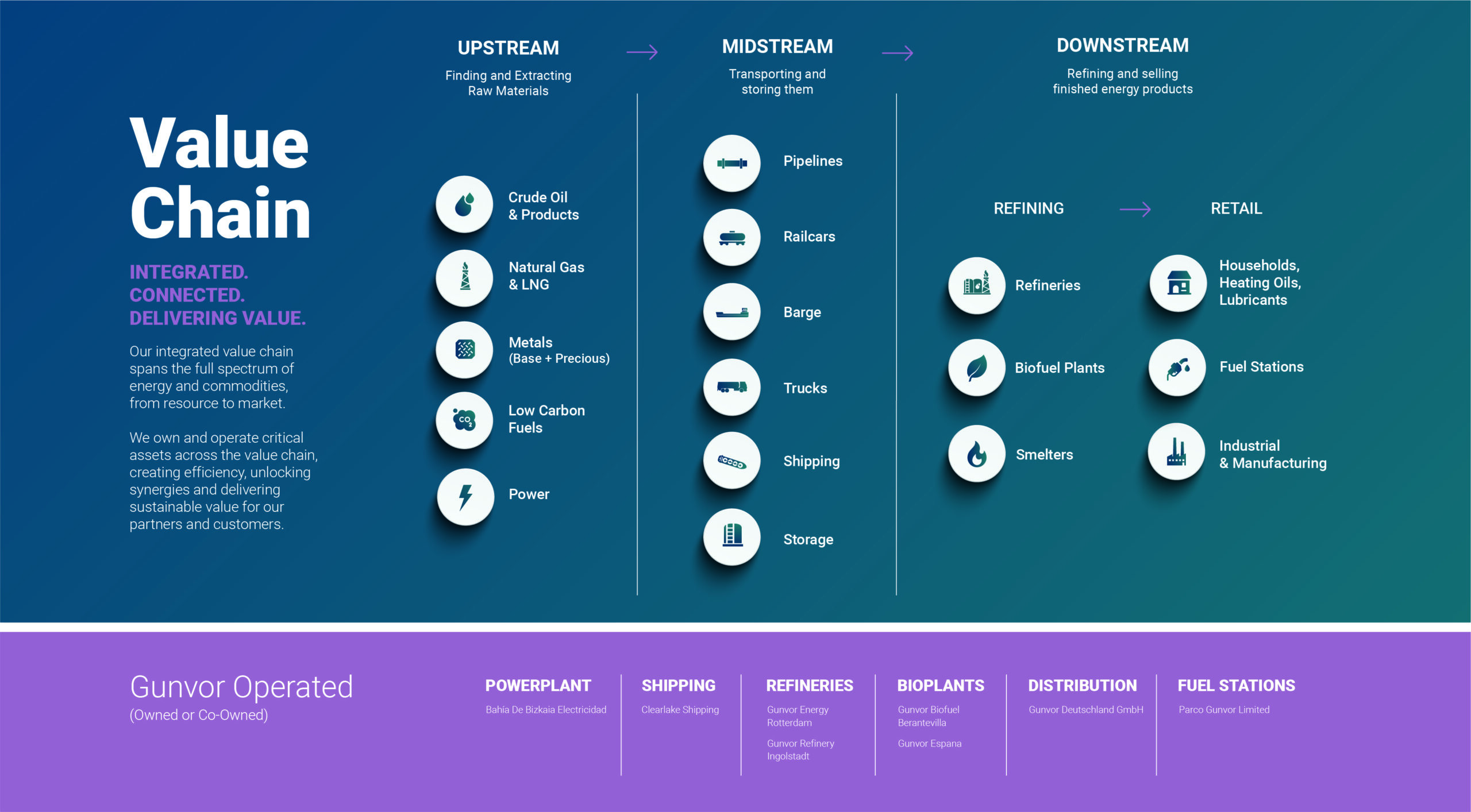
The downstream operations make up a small part of today’s business landscape, however as part of its diversification efforts, Gunvor is exploring potential expansion opportunities in this area. Gunvor has not expanded downstream operations since its acquisition of Parco Gunvor Limited in Pakistan. With the complexity of downstream in its value chain, Gunvor remains committed to further examine how its IROs might be affected.
SBM-2Interests and views of stakeholders:
Gunvor’s stakeholders, both internal and external, play a crucial role in the Company’s ability to create and deliver value. Gunvor’s DMA and sustainability disclosures highlight the most significant topics for its stakeholders, reflecting key interdependencies and impacts across the value chain.
| Stakeholder Group | Type of engagement | Reason of engagement | Value creation |
|---|---|---|---|
 Own workforce Own workforce |
Performance reviews, social events, trainings, employee surveys | Professional development, job satisfaction & wellbeing, inclusion | Career advancement & skill development, wellbeing |
 Suppliers and business partners Suppliers and business partners |
Supplier screenings on human rights and environmental issues, risk-based supplier assessments as part of ongoing human rights due diligence | Responsible supplier management, compliance with Code of Conduct and Ethics, Modern Slavery statement and HSEC Policy | Stable relationship, improved access to credit |
 Customers Customers |
Formal and informal engagements | Value creation and trust | Positive client relationships, Business growth |
 Shareholders Shareholders |
Annual General Meeting, Annual reporting | Long-term growth, strong financial performance, viability of long-term business strategy | Reliable and transparent information, enhance positive financial return through strong growth |
 Banks Banks |
Daily information sharing, due diligence meetings | Access to financing | Business growth |
 Civil Society Civil Society |
Proactive information sharing, newsletters, media briefings | Presence in society, mitigation of any short-term adverse effects refining | Community voices are taken into consideration when planning a project |
 Industry Associations Industry Associations |
Participation in industry-specific associations promoting good practices and operations, such as SuisseNégoce, the Swiss commodity trading association | Increasing awareness of external expectations and advancements | Partnerships, support into navigating regulatory advancements, alignment on industry specific issues |
Material impacts, risks and
opportunities:
Gunvor’s business approach and business model are structured to adapt to the shifting energy landscape while maintaining financial stability. Our operations generate various impacts, risks, and opportunities (IROs) across environmental, social, and governance aspects. Since 2024, Gunvor is voluntarily disclosing its material IROs in alignment with the ESRS.
As part of the Sustainability Statements, the term “impact” refers to both actual and potential sustainability-related effects on people and the environment linked to our business activities. These impacts may be either positive or negative. “Risks and opportunities” encompass sustainability-related financial risks and opportunities, including those arising from dependencies on natural and human resources.
Unless otherwise specified by context, when referring to impacts, risks, and opportunities within the Sustainability Statements, these terms align with the definitions provided by the ESRS.
Gunvor’s evaluation of impacts, risks, and opportunities follows the double materiality principle, which requires assessing sustainability matters from two perspectives:
- Impact materiality – the actual or potential effects of our business on the environment and society.
- Financial materiality – the extent to which sustainability matters influence or are expected to influence Gunvor’s financial position.
A matter is considered material for reporting if it meets the criteria for impact materiality, financial materiality, or both.
Double Materiality Assessment (DMA):
Gunvor carried out its first DMA in 2024 with the support of Impaakt, a Swiss based Company specialized in ESG reporting.
- Stakeholder groups identified were the employees, the banking partners, and the civil society (as provided by Impaakt – refer to their website for more info).
- The DMA assessment was shared with a representative sample of each stakeholder group.
- All stakeholder groups were weighted equally in the final outcome of the assessment.
- Gunvor received 4,623 assessments, with an average participation of 52% of the total stakeholders approached.
- The consultation period lasted approximately 2 months and was carried out from the beginning of August to end of September 2024.
The double materiality assessment has identified 20 material topics, out of which 14 were direct and 6 indirect, with 15 actual and 5 potential impacts. Whereby direct impact refers to a sustainability impact that arises immediately from the Company’s own operations, whilst indirect is an impact which occurs outside the Company’s direct control, however it still remains part of the value chain (upstream or downstream). Information relating to Gunvor’s approach to managing individual impacts, risks and opportunities through policies, actions, metrics, and targets can be found in the topical sections of this report.
DMA Matrix
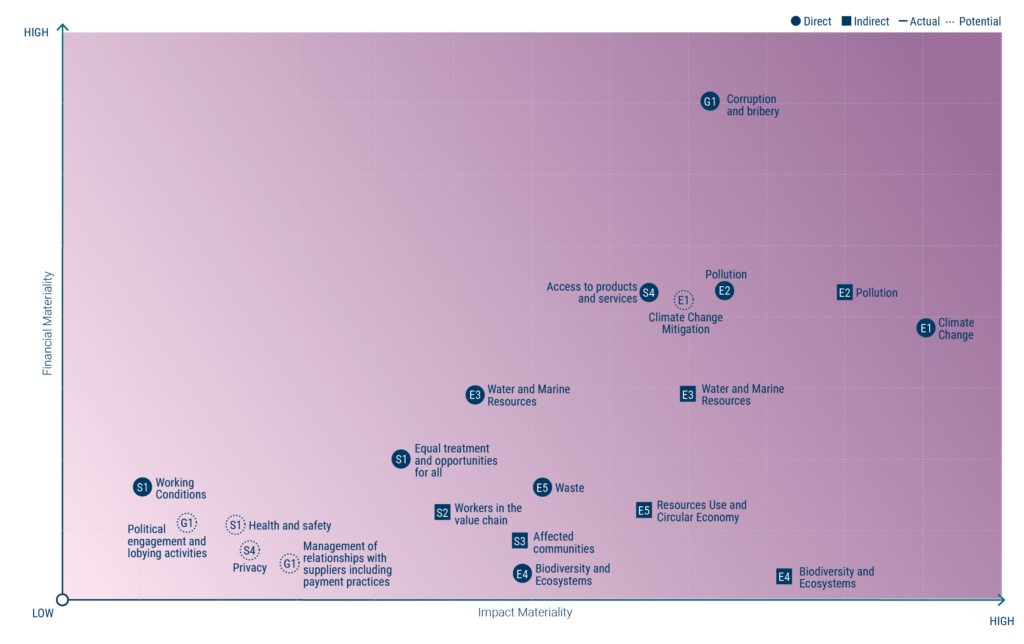
Financial Materiality:
Risk and Opportunity assessments are composed of:
- Magnitude – scale, scope, and irremediability of an impact
- Likelihood – how likely is the impact to become actual
- Time horizon – how soon is the impact likely to occur
Determining material topics and disclosures:
After the assessment and identification of the material topics, the Group applied the double materiality outcomes to determine its material disclosures for the Sustainability Report. It reviewed a list of potential impacts, risks and opportunities and applied both qualitative and quantitative thresholds. Then, topics deemed material were mapped with respective ESRS disclosure requirements. The topics deemed non-material were assessed in light of the industry Gunvor operates in. As per the process of determining materiality in the ESRS, individual data points were omitted and were classified as non-material.
Description of processes to identify material impacts:
Gunvor aligned the methodology with the ESRS official guidance for assessing topical IROs.
Impact Materiality:
Our Impact Materiality assessment evaluates how our activities affect people and the environment. We assess whether a topic is material based on the actual or potential impact of our operations across the value chain.
Actual impacts were evaluated and scored based on their severity and likelihood.
Severity is defined by:
- Scale – how large the impact is
- Scope – how widespread the impact is
- Irremediability – ability to restore or reverse the negative impact
In addition, for potential impacts the assessment will consider two additional sub-dimensions named:
- Likelihood – how likely is an impact to become actual
- Time Horizon – how soon is the impact likely to materialise
Gunvor followed Impaakt’s methodology to evaluate its impact materiality scoring; stakeholders rate the materiality of the predefined topics from a scale of 1 to 5 for each of the severity components.
Disclosure Requirements in ESRS covered by the undertaking’s sustainability statement
IRO CLASSIFICATION
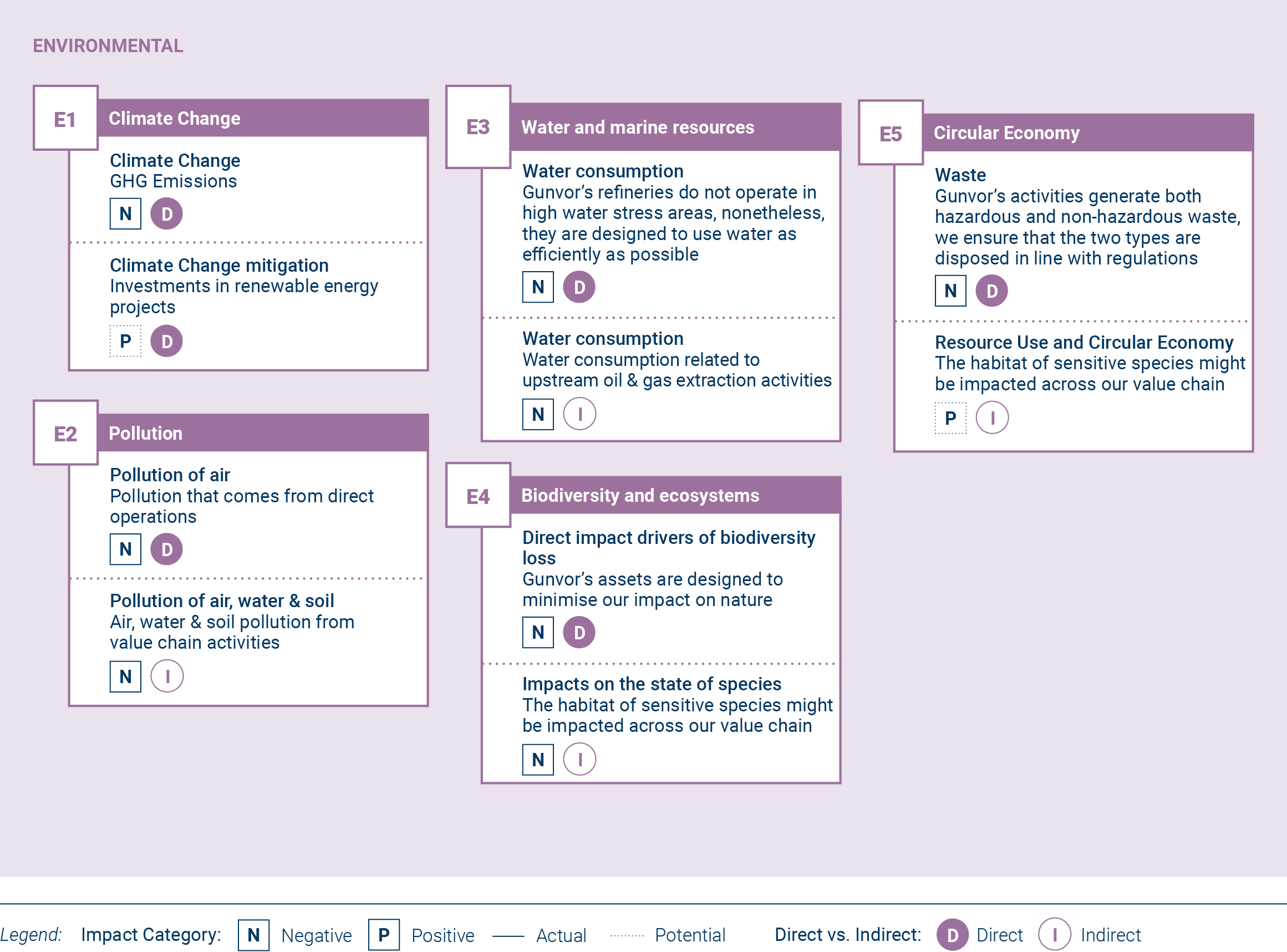
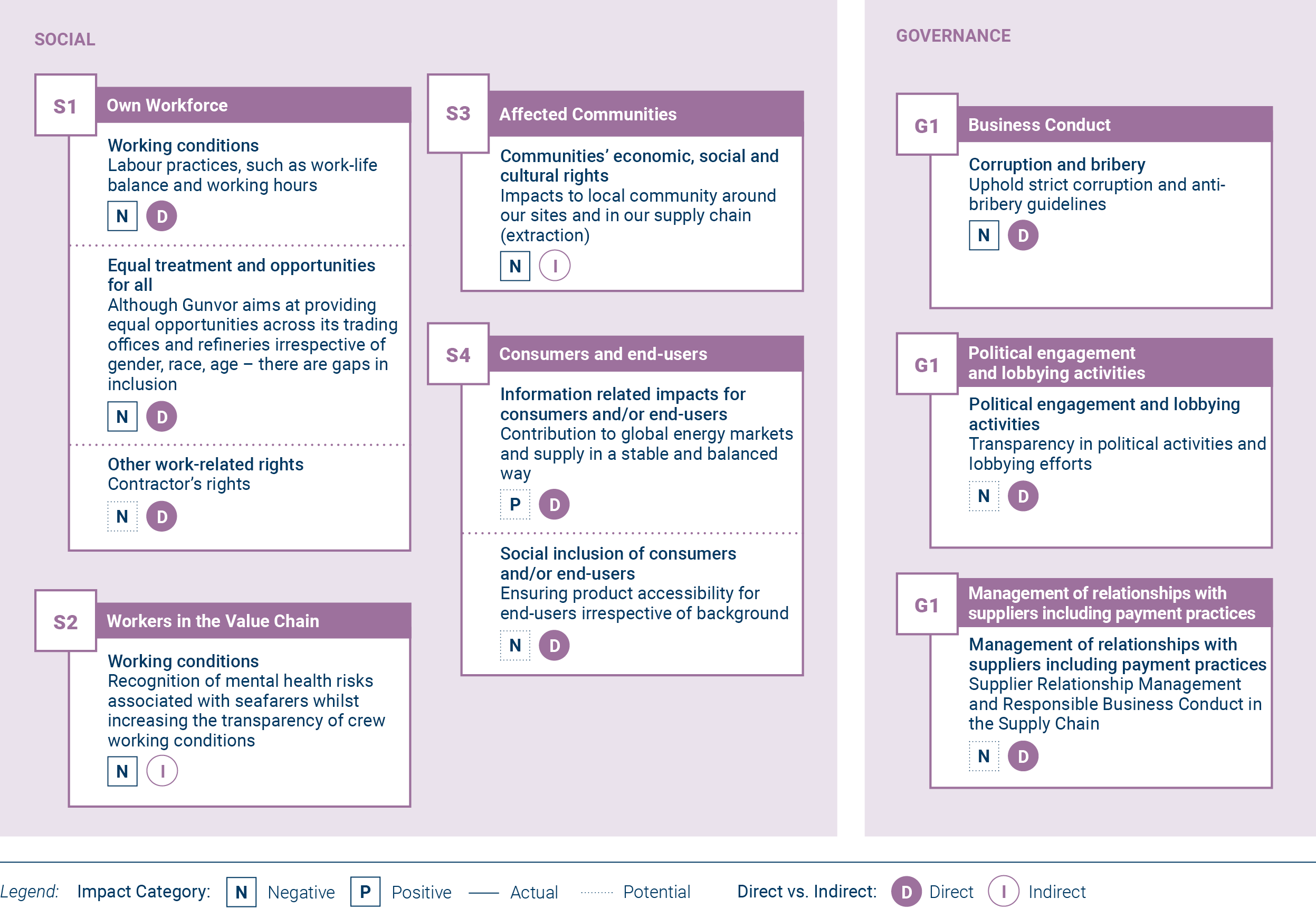
Disclosure Requirements in ESRS covered by the undertaking’s sustainability statement
Following the identification of the key Impacts, Risks and Opportunities (IROs), showcased in the table above, the Company will undertake detailed assessments to precisely determine how these IROs align across Gunvor’s value chain, clearly mapping their position and influence within the operational and strategic framework. Furthermore, each IRO will be categorised according to the relevant ESRS time horizons – short-term, medium-term, and long-term to ensure proactive management ahead of any regulatory requirements.
GDR-PPolicies adopted to manage material sustainability matters
Gunvor’s policies are in place to prevent, mitigate and remediate actual and potential impacts and risks whilst enhancing the utilisation of identified opportunities.
The Code of Conduct and Ethics includes the core principles and addresses what is expected from employees and people working on behalf of the Company including anti-bribery and corruption, sanctions, human rights, health and safety.
The Code of Conduct and Ethics for Business Partners sets out expectations on topics similar to what is expected from employees such as anti-bribery and corruption, sanctions, health, safety, human rights and environment.
The Health, Safety, Environmental, Human Rights and Communities Policy (HSEC Policy) is the overarching reference document for health and safety, human rights and environmental topics (including climate change, biodiversity, waste management and resource efficiency).
The Privacy Policy outlines the collection, usage and processing of personal data and ensures full compliance with the EU General Data Protection Regulations 2016/679.
The Modern Slavery Statement aligned with the UK Modern Slavery Act showcases Gunvor’s commitment to identify, prevent and remediate risks and impacts of forced and child labour in our activities.
The Speak-Up Policy aims to encourage and support the workforce in raising concerns related to employee misconduct. It also lays out the principles and responsibilities for our Human Resources department when handling sensitive cases.
The newly developed Responsible Sourcing Policy for the metals and minerals business is aligned with the best standards, including the OECD Due Diligence for Responsible Supply Chains of Minerals from Conflict-Affected and High-Risk Areas (CAHRAs).
These policies play a central role in shaping the nature of our relationships with stakeholders, and ultimately, they are the means we use to ensure the Company adheres to the correct operational standard. Gunvor will continue to monitor the situation and any advancement in the ESRS and update our policies, as applicable.
GDR-AActions adopted to manage material sustainability matters
Gunvor continues to work towards aligning its reporting with the ESRS Mandatory Disclosure Requirement Actions and Targets GDR-A and MDR-T formats. The mapping of the Group’s sustainability initiatives and performance measures against the ESRS GDR framework includes:
- Gap analysis: Reviewing Gunvor’s current action plans and target-setting methodologies against the ESRS GDR-A and GDR-T criteria and identify alignment gaps.
- Alignment workshops: Engaging cross-functional teams (Sustainability, Corporate Finance, and Compliance) to translate ESRS actions and target requirements into specific objectives and tasks.
- KPI coordination: Embedding ESRS-aligned metrics within the established KPIs to ensure consistent performance tracking.
- Governance enhancements: Defining clear roles, responsibilities, and approval pathways to maintain alignment between committee-approved sustainability commitments, ESRS GDR disclosures, and day-to-day management reporting.
Targets adopted to manage material sustainability matters
The following targets are embedded in Gunvor’s corporate facilities and forming forming part of the Group’s forward-looking sustainability commitments across climate, shipping, investment, and human rights.
For climate and energy transition, Gunvor targets a reduction in Scope 1 and Scope 2 emissions against the 2019 baseline. The Group’s pathway is to reduce Scope 1 and Scope 2 emissions by 50% by 2025 (achieved), 51% by 2026, and 52% by 2027 and 2028.
For shipping, Gunvor targets an improvement in the energy efficiency of its time chartered fleet against the 2023 baseline of 18.55 gCO2/t.nm. The target pathway is to reduce the CO2 intensity of the TC fleet by 13.75% by 2025 (achieved), 15% by 2026, 20% by 2027, and 25% by 2028.
In relation to human rights, Gunvor targets the assessment of all sites and joint ventures under the TwentyFifty (external consulting firm) methodology, with corrective action plans developed where required. Gunvor also targets the phased assessment of critical suppliers against human rights requirements. This includes the assessment of three additional critical suppliers by 2025, three additional critical suppliers by 2026 together with a Human Rights Due Diligence Framework for Parco Gunvor Limited (PGL), three additional critical suppliers by 2027 together with a supplier human rights risk-rating grid integrated into the compliance management system, and two additional critical suppliers by 2028 together with a Supplier Selection Framework.
In addition, Gunvor applies an ongoing target to assess all new assets and joint ventures for human rights risks within 12 months of acquisition or establishment.