Policies related to resource use:
Gunvor’s approach to resource use and circular economy is governed by the Group HSEC Policy (please see ESRS2), which sets out the Group’s environmental expectations across all industrial operations including: refineries, storage terminals, biodiesel production facilities, and maritime activities; as well as for contractors and third-party operators working on Gunvor’s behalf.
The environment section of the HSEC Policy commits Gunvor to:
- Applying the appropriate waste procedures across all operations
- Minimising the generation of hazardous and non-hazardous waste at source
- Ensuring proper waste classification, segregation, tracking, and disposal through certified third-party operators where on-site treatment is not feasible
- Reducing reliance on virgin and non renewable material inputs where technically and economically viable alternatives exist
These commitments are aligned with the principles of the EU Circular Economy Action Plan and are consistent with Gunvor’s broader sustainability ambitions, including the Group’s growing circular economy trading activities, such as the conversion of used cooking oil and other waste feedstocks into biodiesel, the trading of pyrolysis oil derived from end-of-life materials, and ongoing collaboration on industrial-scale waste tyre recycling.
In relation to the use of fossil resources, please refer to the section on Climate Change (E1) in this report.
Actions and resources:
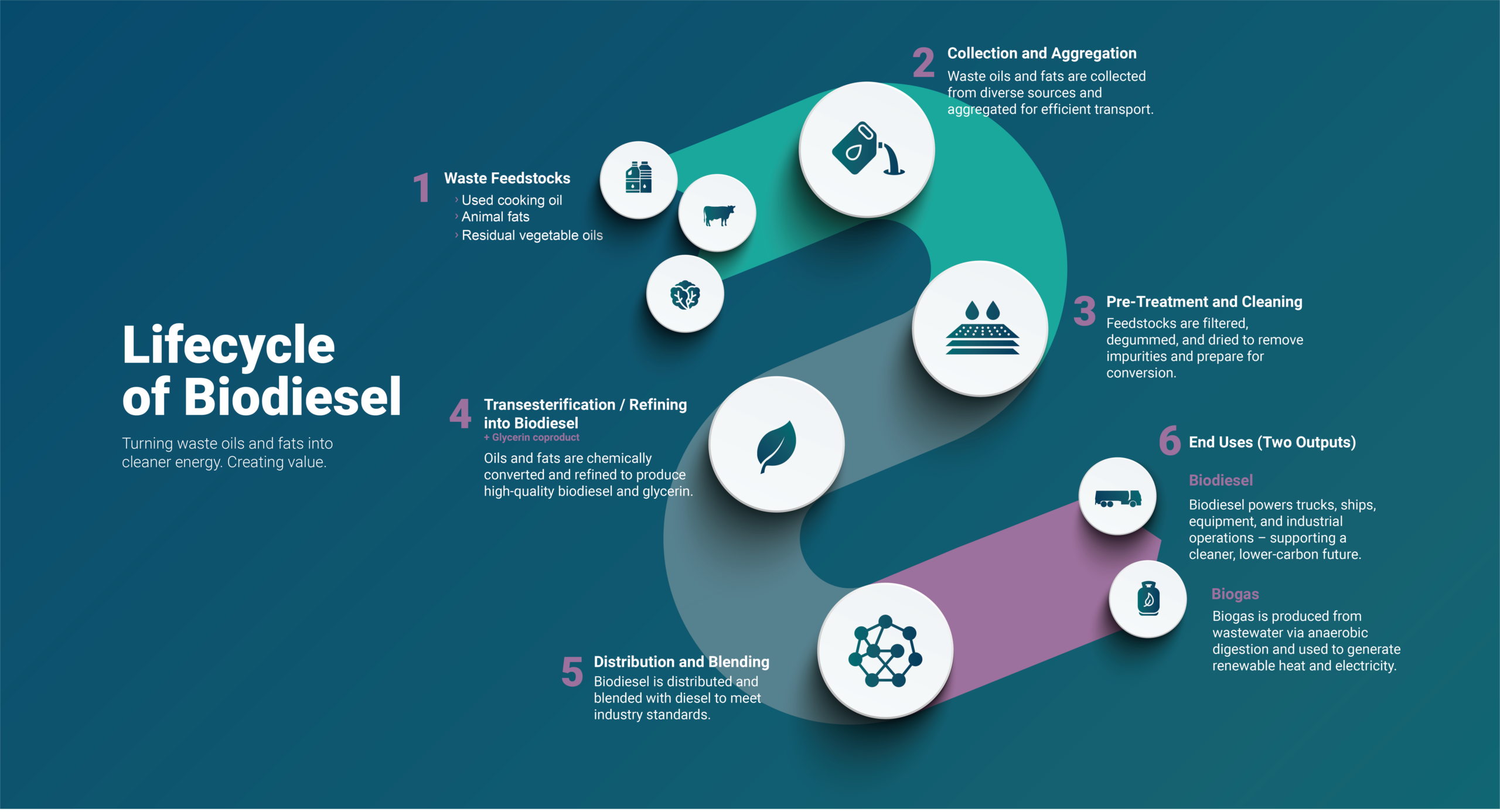
Gunvor contributes to a circular economy by means of two Spanish biodiesel plants, where we convert a waste stream (used cooking oil) into a low carbon fuel (biodiesel).
In 2025, Gunvor expanded its circular economy activities through a new collaboration with New Energy (NE-TECH) to develop industrial-scale waste tyre recycling, enabling the conversion of end-of-life tyres into circular feedstocks. This partnership converts a significant waste stream away from landfill and incineration toward productive reuse as a secondary raw material.
Across other operations Gunvor focus on the reduction of energy use and GHG emissions.
E5-3Targets related to resource use:
Gunvor continued the internal reporting of the waste percentage that is being recycled throughout 2024 and 2025. Having now accumulated two years of data, it is developing a baseline from which to benchmark our performance for upcoming reporting periods.
As explained above, Gunvor continues to focus its efforts on reducing energy use and GHG emissions across its operations and aims to build on this progress where feasible.
E5-4Resource inflows:
Gunvor’s trading activities comprise large quantities of resources such as oil, gas, and metals. Inherent to trading is that the inflow equals the outflow over the longer term, without consumption by the Company.
Regarding its operational activities, Gunvor limits itself here to a qualitative description of the significant resource inflows. For refining, these are mainly crude oil and natural gas. The biodiesel plants use vegetable oils, principally used cooking oil, to produce biodiesel. The powerplant (BBE) uses natural gas to produce electricity. In 2025, the collaboration with NE-TECH introduced end-of-life tyres as a new circular feedstock inflow, converted into pyrolysis oil as a secondary raw material for chemical recycling.
E5-5Resource outflows:
Total waste in 2025 decreased significantly to 15,234 tonnes, the lowest level recorded in the reporting period and a reduction of approximately 43% compared to 2024 (26,546 tonnes). The elevated figures observed in 2020 and 2023 are attributable to soil remediation and demolition projects, which generate significant one-off quantities not reflective of steady-state operational waste levels. The absence of comparable one-off projects in 2025 is the primary driver of the year-on-year reduction.
Non-hazardous waste decreased from 22,974 tonnes in 2024 to 9,294 tonnes in 2025. This decrease is primarily attributable to a general improvement in waste operations.
The percentage of waste that is recyclable improved to 67% in 2025, the highest level recorded since internal tracking commenced in 2023, continuing the recovery from 50% in 2024. This improvement reflects ongoing efforts to enhance waste stream segregation across terminal and refinery sites.
Gunvor’s waste management is focused on separation into distinct waste categories and selecting the most appropriate treatment destination for each, with the support of specialised contractors. This work is heavily regulated to protect the environment, and all waste is transported to licensed waste-processing sites.
| 2020 | 2021 | 2022 | 2023 | 2024 | 2025 | |
| Total Waste | 39196 | 23784 | 26427 | 35549 | 26546 | 15234 |
| Hazardous Waste | 9702 | 5029 | 7060 | 6230 | 3572 | 5940 |