
Transition plan and consideration of biodiversity:
Gunvor recognises that its refining, maritime and retail operations interact with biodiversity and natural ecosystems across multiple pathways, including land use at operational sites, atmospheric and waterborne emissions, and shipping activities that traverse ecologically sensitive marine environments. These interactions are acknowledged within Gunvor’s broader environmental strategy, and biodiversity considerations are progressively being embedded into the company’s operational governance and site management practices
As part of its preparation for CSRD compliance, Gunvor is developing a structured resilience analysis to assess how biodiversity-related risks and dependencies may affect its long-term business model, particularly in the context of increasing regulatory scrutiny under the EU Biodiversity Strategy for 2030.
Disclosure Requirement SBM 3 – Material impacts, risks and opportunities and their interaction with strategy and business model
Gunvor’s primary sites with potential interactions with biodiversity-sensitive areas are its refineries
in Rotterdam (Netherlands) and Ingolstadt (Germany), together with its biofuel plant in Berantevilla (Spain). A preliminary site-level assessment has been conducted to identify the proximity of each operational site to designated protected areas, included Nature 2000 sites, and to evaluate the nature of potential biodiversity impacts.
Based on this preliminary assessment, Gunvor’s refinery operations do not involve direct land conversion, do not intrude upon designated protected areas, and are not known to adversely affect threatened or protected species populations. Air emissions from production sites are managed within permitted limits, and current monitoring data does not indicate
significant negative effects on adjacent sensitive ecosystems. However, Gunvor acknowledges the inherent limitations of this preliminary assessment and is committed to undertaking a more comprehensive biodiversity impact evaluation using established methodologies in the near term.
In terms of the indirect impact, Gunvor’s maritime transportation activities carry biodiversity risks associated with ballast water discharge, hull fouling, underwater noise, and the potential for fuel spills in ecologically sensitive marine corridors. These are managed through the technical measures described under E4-3.
| Operational Site | Operations | Biodiversity sensitive areas |
Ecological status | Negative impact towards land & soil |
Threatened species |
|---|---|---|---|---|---|
|
GRI
Gunvor Refinery Ingolstadt
|
Oil refinery | None | Located in urban area. The nearest Natura 2000 area is 2 km away (Donauauen zwischen Ingolstadt und Weltenburg) |
No | No |
|
GER
Gunvor Energy Rotterdam
|
Production of fuels from imported naphtha and gasoil |
None | Located in industrial area (Rotterdam port). The nearest Natura 2000 area is 3.3 km away (Solleveld & Kapittelduinen) |
No | No |
|
GBH
Gunvor Biodiesel Huelva
|
Production of biodiesel | None | Located in industrial area. The nearest Natura 2000 area is 0.7 km away (Marismas del Odiel) |
No | No |
|
GBB
Gunvor Biodiesel Berantevilla
|
Production of biodiesel | None | Located in industrial area. The nearest Natura 2000 area is 0.5 km away (Zadorra ibaia / Río Zadorra) |
No | No |
|
GDG
Gunvor Deutschland GmbH
|
Unmanned fuel stations (Bavaria, Germany) |
None | Located in urban areas | No | No |
|
BBE
Bahía de Bizkaia Electricidad
|
Electricity production | None | Located in industrial area. The nearest Natura 2000 area is 2 km away (Ría del Barbadun) |
No | No |
|
PGL
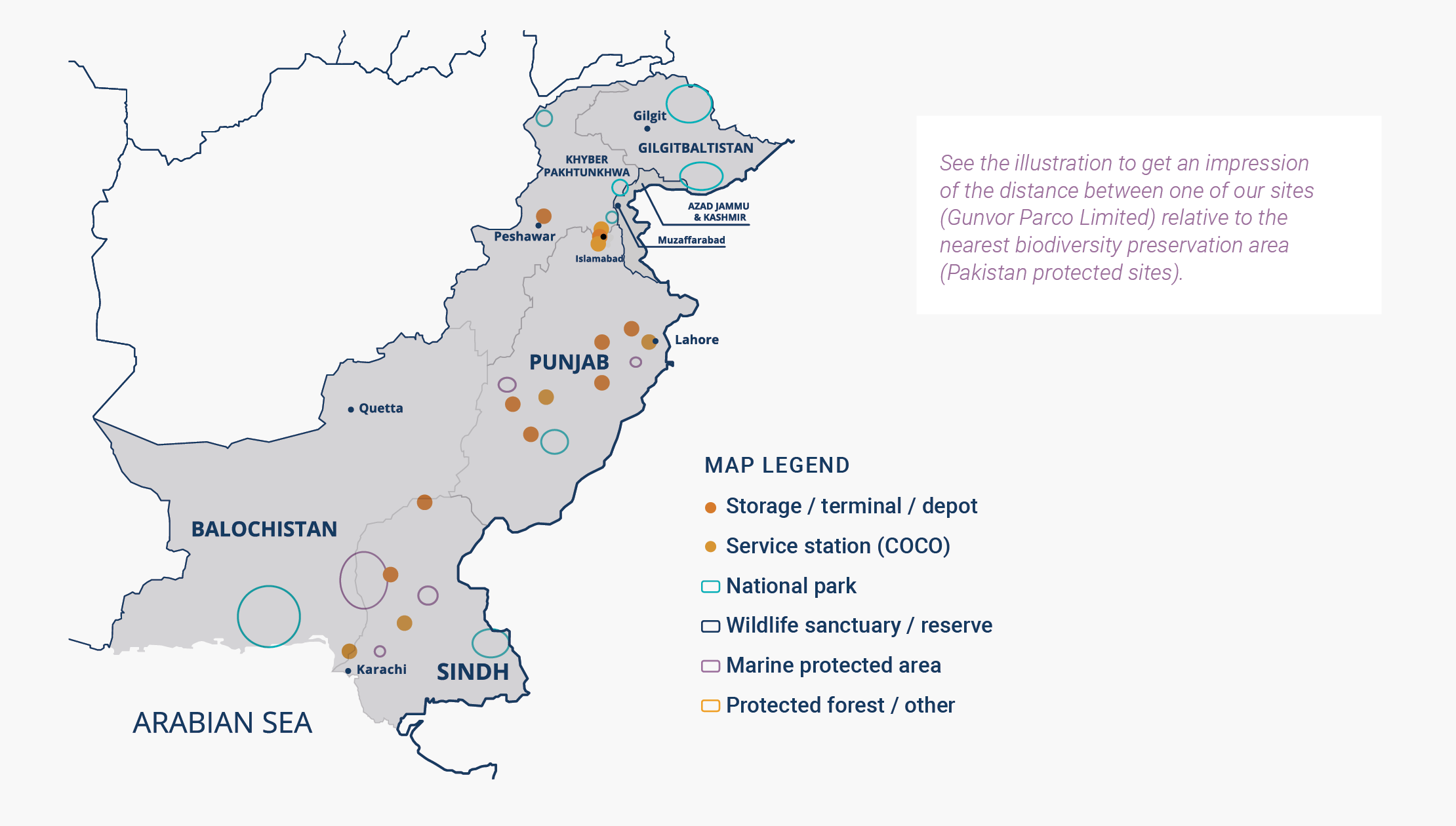
Parco Gunvor Limited
|
Downstream retail fuel stations |
None | The stations are inherently located in urban areas. However, the terminals and depos are in industrial areas. |
No | No |
Policies related to biodiversity and ecosystems:
Gunvor’s approach to biodiversity protection is governed within its Group HSEC Policy, under which all operational entities are required to identify and monitor environmental impacts, implement pollution prevention measures, and maintain compliance with applicable environmental permits and regulations. Biodiversity is explicitly named within the policy’s Environmental Expectations as a priority area, specifically in relation to legally protected areas and biodiversity, alongside resource efficiency, pollution prevention, and waste management.
At the operational level, this means sites are required to establish environmental management systems that account for proximity to sensitive ecosystems, and to set objectives for continual improvement in environmental performance, which includes minimising adverse effects on local habitats and species.
On the maritime side, Gunvor’s vessel operations are managed in line with the International Convention for the Control and Management of Ships’ Ballast Water and Sediments (BWM Convention), supporting the prevention of invasive species introduction into marine ecosystems.
Gunvor acknowledges that a dedicated standalone biodiversity policy would further strengthen its governance framework in line with evolving ESRS E4 expectations. The development of such a policy is under active consideration as part of the company’s broader CSRD preparation programme. Further details on Gunvor’s overarching policy framework are provided in the GDR-P section of this report.
Policies related to biodiversity and ecosystems:
Gunvor’s refinery sites in Rotterdam and Ingolstadt occupy large industrial footprints that, through active management, provide a habitat for a range of local species.
At Gunvor Refinery Ingolstadt (GRI), external ecological experts were engaged to conduct a site assessment and recommend targeted conservation measures. Whilst efforts to reduce environmental impact are ongoing, GRI has positively contributed to a structured biodiversity initiative aimed at enhancing local ecosystems, including the installation of nesting and roosting structures and the management of green spaces to support wildlife.
The site already hosts a documented range of species, including birds such as nuthatches, redstarts, various tit species, and occasionally falcons that nest on elevated structures. At night, bats are frequently observed, while ground-dwelling animals like hedgehogs, weasels, cats, and dormice inhabit the surrounding areas. This reflects a site environment that, despite its industrial function, provides a meaningful ecological corridor within the surrounding landscape.
Maritime Operations
Gunvor’s shipping activities carry specific biodiversity risks, principally the transfer of invasive aquatic species via ballast water, biofouling on vessel hulls, and atmospheric and waterborne pollution in ecologically sensitive marine areas. Gunvor addresses these risks via the following technical measures:
- Ballast water treatment systems installed across the fleet to neutralise invasive species before discharge, in compliance with the BWM Convention.
- Exhaust gas cleaning systems reduce sulphur oxide emissions, limiting acidic atmospheric deposition and its effects on coastal and marine ecosystems.
- Scheduled hull cleaning and eco-friendly antifouling coatings minimise biofouling and the associated transfer of non-native species between geographically distinct marine environments, while improving fuel efficiency.
Targets related to biodiversity and ecosystems:
Gunvor does not currently have quantitative targets specifically designated for biodiversity and ecosystem outcomes. However, targets and site-specific expectations in relation to environmental emissions and pollution have been set (see respective sections).
Meaningful target-setting requires ecological baseline data at the site level, which Gunvor is actively developing. As this baseline data matures, it will provide the empirical foundation for setting measurable, time-bound targets.
Gunvor has already identified the following as priority areas for biodiversity target development in the near term:
- Site-level habitat quality establishing KPIs for ecological conditions at refinery site perimeters, building on the GRI biodiversity initiative and external assessments already underway.
- Ballast water compliance formalising the fleet-wide BWM Convention compliance as a quantifiable target, given the link between ballast water management and invasive species risk in marine ecosystems.
- Protected area proximity establishing a commitment that no future operational expansion will encroach upon or materially degrade Natura 2000 sites or equivalent designated areas.
These targets will be developed in alignment with the Science Based Targets for Nature (SBTN) framework where applicable, and Gunvor expects to be able to disclosure formal biodiversity targets in the next reporting cycle.
E4-5Impact metrics related to
biodiversity change:
Gunvor does not currently report metrics specifically designed to measure biodiversity or ecosystem condition outcomes. However, several environmental metrics reported elsewhere in this report directly address the key pressure pathways through which Gunvor’s operations interact with biodiversity, and are presented below in that context.
| Pressure Pathway | Relevant Metric | Disclosure Section |
|---|---|---|
| Atmospheric emissions affecting air quality and acid deposition on ecosystems |
SOx, NOx, particulate matter emissions | E2 |
| Water pollution affecting aquatic habitats | Wastewater discharge volumes (1.5 million m³) | E3-4 / E3-2 |
| Freshwater abstraction competing with ecosystem water needs | Total water consumption (2.5 million m³) | E3-4 |
| Climate change as a systemic driver of biodiversity loss | Scope 1, 2 and 3 GHG emissions | E1 |
| Invasive species transfer via ballast water | Fleet-wide ballast water treatment system installation status | E4-3 |
Gunvor is committed to developing nature-specific metrics aligned with the TNFD framework and, where applicable, the Science Based Targets for Nature (SBTN) methodology. The Ingolstadt biodiversity monitoring initiative represents the first step in building the empirical baseline from which meaningful outcome metrics can be constructed, with the aim of incorporating these into future reporting cycles.
E4-6Anticipated financial effects:
Gunvor has not yet quantified the financial effects of biodiversity and ecosystem-related risks and opportunities, reflecting the early stage of its nature-related risk assessment programme.
Notwithstanding the absence of quantified data, Gunvor has identified the following plausible categories of financial exposure based on its DMA conclusions and the broader regulatory and market trajectory:
Physical Risks
- Ecosystem degradation in the regions where Gunvor operates could affect the availability and quality of freshwater resources essential to refinery processes, with potential implications for operational continuity and increased water treatment costs.
- Decline in marine ecosystem health, driven by cumulative industry impacts including those in Gunvor’s value chain, could increase regulatory constraints on shipping routes through ecologically sensitive areas.
- Transition Risks
- Increasingly stringent environmental permitting requirements under the EU Nature Restoration Law and evolving Natura 2000 buffer zone regulations could impose additional compliance costs or constrain operational flexibility at sites in proximity to designated protected areas.
- Growing lender, and counterparty scrutiny of nature-related risks, including through TNFD-aligned disclosure expectations may affect Gunvor’s access to and cost of capital if biodiversity performance is not adequately evidenced over time
- Tightening ballast water and antifouling regulations in key shipping jurisdictions could require accelerated fleet investment beyond currently planned maintenance cycles.
Opportunities
- Proactive biodiversity management at refinery sites can reduce regulatory friction, strengthen community license to operate, and support more favorable outcomes in environmental permit renewals.
- Early adoption of TNFD-aligned disclosure positions Gunvor competitively with financial institutions that are increasingly screening for nature-related risk management capabilities.
- Investment in habitat enhancement at operational sites, as demonstrated at Ingolstadt, can generate reputational and stakeholder engagement value at relatively modest cost.
Gunvor is committed to developing scenario-based financial quantification of these exposures in a future reporting cycle, drawing on the outputs of its ongoing site-level biodiversity assessment program and emerging TNFD sector guidance for the oil and gas industry.