
Volume History
Volume by product MMT
Transition Plan for climate change mitigation
Gunvor remains committed to meeting today’s demand for energy and raw materials responsibly, while enabling future systems by providing the energy and materials required for a lower-carbon economy. This ambition reflects the Company’s role as a global commodities trader operating across complex value chains where reliable supply must be balanced with the imperative to decarbonise. Gunvor continues to work towards adjusting the strategy to remain compatible with the transition to a sustainable economy and with limiting global warming in line with the Paris Agreement.
Gunvor’s decarbonisation activities are centred on four key areas:
- Reducing emissions from its operated assets and shipping activities
- Increasing transparency and management of value chain emissions
- Growing the volumes of lower-carbon and transition commodities in its trading portfolio
- Scaling investments in energy transition assets
Gunvor acknowledges that further progress is needed. The Company is working toward developing a credible and comprehensive transition plan in line with evolving regulatory requirements that reflects the present and future scope of the business. Gunvor has established the foundational components for this future framework:
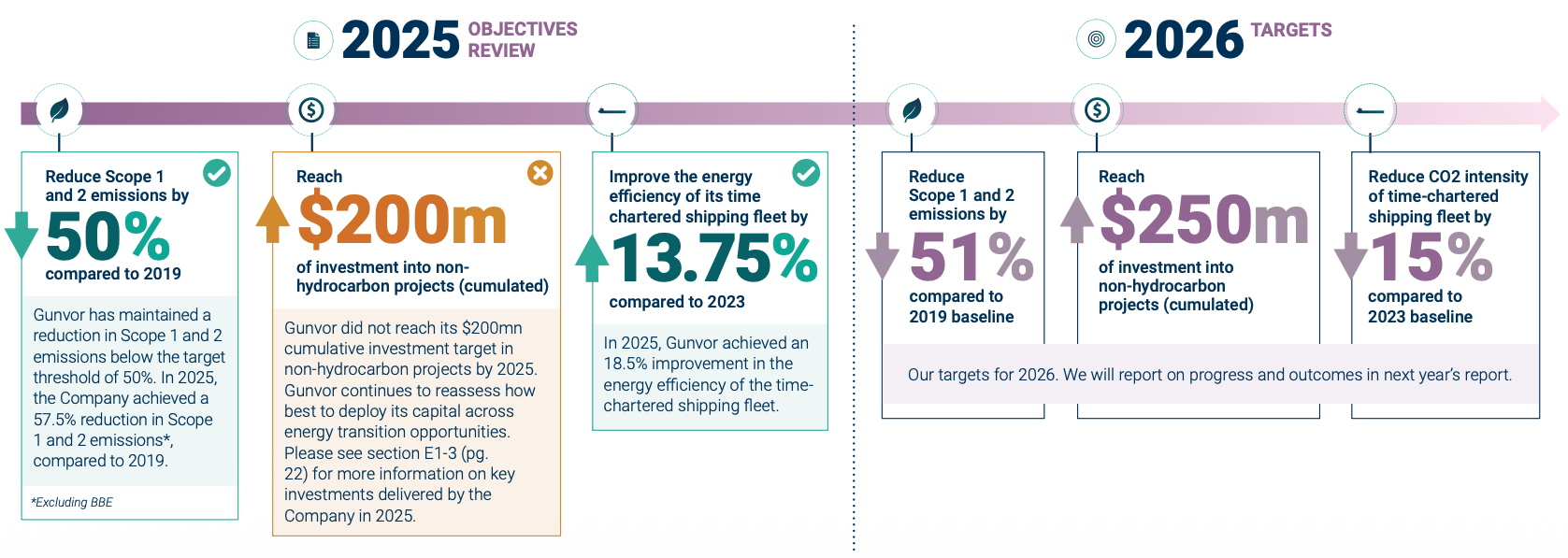
Gunvor has set and achieved greenhouse gas emissions reduction targets for its operations. In 2025, Gunvor reached a 57.5% reduction in Scope 1 and 2 emissions compared to 2019 baseline. The Company is assessing its Scope 1 and 2 target for new acquisitions, notably BBE, to ensure consistency and completeness moving forward.
Gunvor also maintains its target to reduce the CO2 emissions intensity of the time chartered fleet by 20% by 2027, compared to a 2023 baseline.
The Company continues to systematically calculate and disclose Scope 3 emissions from traded products. Each year it seeks to improve the coverage, granularity and reliability of its Scope 3 data as a key component of transition plan development. Gunvor recognise that reducing carbon intensity of traded products cannot be achieved by the Company alone and is therefore strengthening emissions transparency across the value chain and improving analytical capabilities to identify effective intervention points.
In 2025, the trading of biofuels, natural gas and LNG formed together circa 1/3 of the traded portfolio. Gunvor’s metals trading business also continued to grow, supporting demand for transition-critical materials. The Company remained absent from any physical coal trading, as it has since 2018.
E1-2Policies:
Gunvor formalises its commitments, principles and expectations relating to Health, Safety, Environment, Human Rights and Communities in its Group HSEC Policy. The policy is overseen by the Group HSEC and Operational Risk Committee and establishes a consistent set of standards, responsibilities and controls designed to prevent harm to people, respect human rights, and protect the environment.
Climate change is addressed under the Environmental Expectations section and includes commitments to identify and monitor environmental impacts and set targets to track and improve environmental performance. Expectations are also extended, where relevant, to suppliers and business partners, ensuring alignment across the value chain.
Further detail is provided in the MDR-P section of this report (see p. 22).
E1-3Actions and resources in relation to climate change policies:
Scope 3 Category 11 (use of sold products) continues to represent Gunvor’s largest source of greenhouse gas emissions, accounting for over 75% of total emissions in 2025. While the Group recognises the importance of addressing product emissions, its primary focus remains on reducing emissions in operations and shipping, where it has the greatest level of control and influence. As such, Gunvor is committed to achieve a 20% reduction in CO2 intensity of its time charter fleet by 2027, compared to a 2023 baseline.
Gunvor is expanding its efforts to reduce the emissions intensity of its traded products to support a gradual shift toward lower-carbon energy solutions. Following the management buyout (MBO) in December 2025, Gunvor is restructuring its investment vehicles which include direct energy transition investments.
Gunvor’s actions in 2025 address both climate mitigation and adaptation, spanning portfolio transformation, operational efficiency, low-carbon investments and carbon market participation. Key actions are summarised in the following sections.
Increase in Transition Commodities
Gunvor continued to evolve in 2025 by increasing exposure to lower-carbon commodities. Key initiatives in 2025 included:
- Gunvor partnered with New Energy to advance industrial-scale waste tyre recycling, producing circular feedstocks including circular naphtha. This initiative supports the substitution of virgin fossil-based inputs with recycled materials, contributing to emissions reduction across petrochemical value chains.
- Gunvor entered into a partnership with PureWest to accelerate the adoption of verified low-carbon gas solutions, promoting cleaner energy alternatives and supporting consumer decarbonisation efforts.
- Alongside direct investments in biofuel production facilities, Gunvor established a dedicated biomethane trading capability. This expansion strengthens its role in circular fuel markets, supporting market development and enabling greater decarbonisation benefits for end consumers.
Battery Storage and Renewable Energy
In 2025, Gunvor expanded its participation in renewable energy and flexibility markets through targeted investments and trading activities. Examples include signing a long-term Offtake Agreement with Akashaya Energy for its large-scale Battery Energy Storage System (BESS) in Australia and participating in trading Enwex German Onshore Wind futures on the Abaxx Exchange. These initiatives demonstrate a key expansion in Gunvor’s entry into innovative, sustainable energy solutions.
Sustainability-linked Financings
Gunvor continued to embed sustainability into financing in its main corporate credit facilities. The facilities incorporate sustainability-linked performance indicators aligned with Gunvor’s sustainability strategy and support the Company’s commitment to progressing emission reductions and human rights assessments through accountability integrated into financial mechanisms.
Operational Efficiencies at Gunvor Refinery Ingolstadt (GRI)
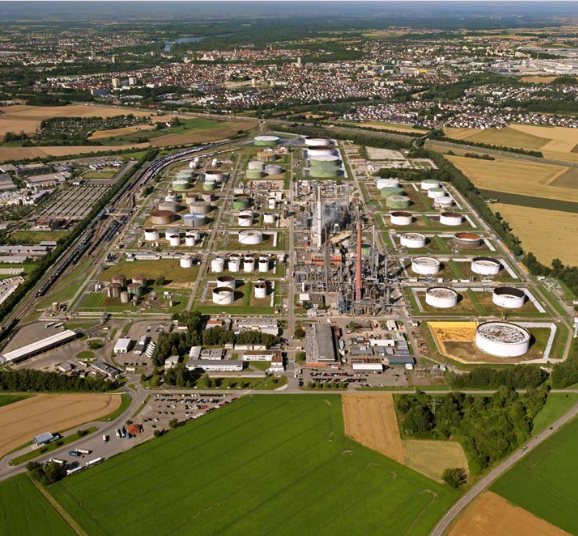
A range of energy efficiency and emission reduction initiatives were implemented at GRI in 2025. These were focussed on upgrading internal heat integration through reboiler duty optimisation in the Fluid Catalytic Cracking (FCC) unit and relocating the slurry rundown draw to improve energy utilisation. Together, these measures are expected to reduce CO2 emissions by approximately 7,500 tonnes per year by making better use of existing heat within the process, contributing to lower overall energy demand.
CASE STUDY
Akaysha Brendale BESS
Gunvor entered into a 12-year offtake agreement for Akaysha Energy’s Brendale BESS development. Located in Brisbane’s outer northern suburbs, the Brendale BESS is a 205 MW facility designed to absorb excess solar generation and can store sufficient energy to supply up to 200,000 homes for approximately two hours. The project will enhance voltage stability across key transmission infrastructure in Queensland and bolster the region’s renewable capability.
Gunvor’s innovative offtake structure demonstrates the economic viability of large-scale battery storage by enabling stable returns through wholesale electricity markets and is expected to accelerate the further deployment of battery infrastructure.
Akaysha Energy specialise in the development, ownership and operation of utility-scale battery storage assets, with expertise spanning energy markets, technology, project development and capital structuring. The company remain an integral player in the expansion of battery storage capacity across Australia.

40+ TWh
ASX trading volumes
(2025)
>600MW
BESS offtake contracts secured with assets
>400MW
Renewable PPA offtake secured with assets
Shipping
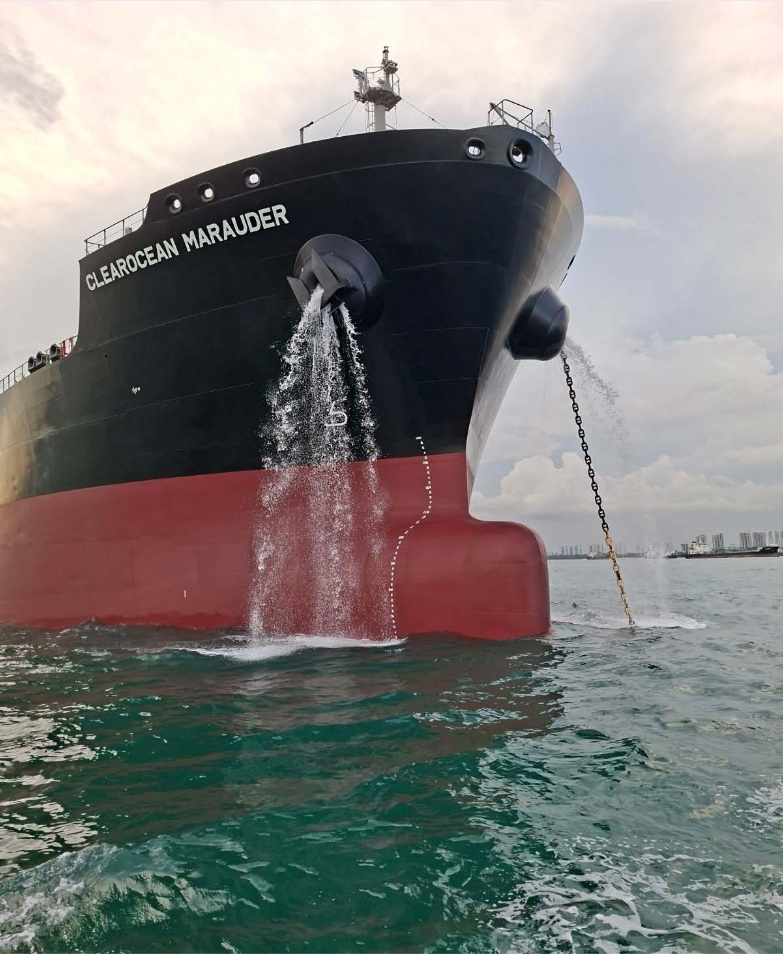
Shipping remains a critical component of Gunvor’s midstream operations where the company directly influence emissions savings outcomes. In 2025, Gunvor’s shipping subsidiary, Clearlake Shipping, has continued to strengthen its approach to maritime decarbonisation through ongoing operational and technological improvements.

Shipping Emissions
| 2020 | 2021 | 2022 | 2023 | 2024 | 2025 | ||
|---|---|---|---|---|---|---|---|
| Fleet Composition – % Eco-vessels | Co-owned | 72% | 100% | 100% | 100% | ||
| Time chartered | 60% | 66% | 50% | 52% | 78% | 68% | |
| Co-owned vessel emissions | CO2e emissions (Scope 1) | 25,046 | 25,046 | 87,888 | 57,679 | 61,905 | 68,167 |
| # ships | 17 | 17 | 9 | 8 | 6 | 7 | |
| Time chartered emissions | CO2e emissions (Scope 3) | 2,245,000 | 2,400,000 | 3,510,000 | 3,360,000 | 4,024,756 | 3,431,733 |
| # ships | 137 | 108 | 113 | 183 | 201 | 184 | |
| Voyage chartered emissions | CO2e emissions (Scope 3) | N/A | 297,000 | 160,000 | 255,000 | 1,301,655* | 1,557,707 |
Project ECO
Gunvor continued to implement operational practices and digital tools to improve vessel efficiency and reduce fuel consumption. Core initiatives include slow steaming, advanced route optimisation, reduced idling in port and the advancement of performance monitoring systems. In 2025, the introduction of live vessel performance monitoring with the support of a third-party specialist has allowed for real time intervention in curbing potential overconsumption from factors such as hull fouling. These measures further strengthen Clearlake’s ability to proactively manage energy efficiency across the fleet.
Embedding Efficiency in Fleet Selection and Maintenance
Gunvor continues to integrate environmental performance criteria into fleet procurement and asset management decisions. When selecting vessels for long-term time charter (TC), priority is given to ships equipped with proven energy efficiency technologies, including:
- Exhaust gas cleaning systems
- Ballast water treatment systems
- Energy-efficient lighting and onboard systems
- Advanced hull and propeller technologies
In parallel, owned vessels undergoing dry docking are assessed for the application of advanced eco-friendly antifouling coatings and performance-enhancing technologies, such as silicon-coated propellers.
Advancing Low-Carbon Vessel Technologies
Gunvor continues to focus on integrating future-ready vessel technologies to reduce lifecycle emissions while maintaining commercial flexibility. The company continues to evaluate new build candidates for long term-charter agreements with purchase options, with new technology dual fuel engines available to reduce the carbon footprint.
Targets related to climate change mitigation and adaptation:
In 2021, Gunvor set a combined Scope 1 and 2 target to reduce absolute emissions compared to a 2019 baseline. The business also maintains an ambition to achieve net zero emissions across all assets by 2050. These targets were designed to align with the Science-based Target Initiative (SBTi) at the time of implementation in order to remain consistent with a 1.5°C global warming scenario.
In 2025, the Company achieved a 57.5% reduction in Scope 1 and 2 emissions compared to a 2019 baseline (2024: -42.8). The emissions reported include all eligible assets except the Bahía de Bizkaia Electricidad (BBE) power plant acquired in 2024, pending its inclusion in the baseline.
Gunvor has also established a Scope 3 greenhouse gas emissions intensity target focussed on its shipping activities, which represent a segment of the value chain where the Company has significant operational influence. Gunvor commits to reduce the CO2 intensity of its time charter shipping fleet by 20% by 2027, from a 2023 baseline. Emissions are calculated using the International Maritime Organisation (IMO) standard well-to-wake methodology. As of 2025, the Company has achieved an 18.5% reduction in CO2 intensity for its time chartered fleet.
Scope 1 & 2 Emissions
| 2019 (Baseline) | 2024 | 2025 | |
|---|---|---|---|
| Scope 1 GHG emissions (tCO2e) – excluding BBE* | 1,674,450 | 936,001 | 760,852 |
| Scope 1 GHG emissions (tCO2e) – including BBE** | 2,481,994 | 1,480,982 | 1,202,915 |
| Scope 2 (market-based) GHG emissions (tCO2e) – excluding BBE * |
107,939 | 4,389 | 5,227 |
| Scope 2 (market-based) GHG emissions (tCO2e) – including BBE** |
110,077 | 6,661 | 7,458 |
| Percentage reduction in Scope 1 and 2 emissions since 2019 (tCO2e) – excluding BBE* |
47% | 57.5% | |
| Percentage reduction in Scope 1 and 2 emissions since 2019 (tCO2e) – including BBE** |
43% | 53% |
**Emissions restated to include 100% of Scope 1 and 2 emissions of BBE and Parco in 2019, 2024 and 2025.
*** The data from 2024 have been modified from our previous year’s report due a data quality error that has now been addressed.
2025 / 2026 Objectives
Forecast Scope 1 and 2 Emissions
The drivers of Gunvor’s forecasted Scope 1 and 2 emissions reflect the operational role of each asset, expected utilisation levels and the implementation of targeted efficiency measures over time.
At BBE, emissions are inherently variable due to the nature of the asset’s role in providing balancing capacity and grid support to intermittent renewable power. As a result, emissions are primarily driven by the utilisation rate of the generators, which fluctuate in parallel with market demand and renewable output. This leads to year-on-year variability in emissions rather than a steady trajectory. In light of this, with support from a specialist third party, the asset has completed a study into fuel switching and Carbon Capture and Storage (CCS) as potential decarbonisation options. A planned three-month outage in 2028 is also expected to temporarily reduce emissions in that year.
The emissions trajectory of GRI is shaped by a structural programme of reduction initiatives, calculated relative to a normalised production capacity. Key measures include the increased reuse of waste heat through enhanced integration between processes and the installation of more efficient heat exchangers. Upgrades to boilers and turbines are expected to reduce fuel consumption while other incremental improvements such as applying advanced coatings to minimise heat loss will also improve efficiency. Longer term, increased imports of renewable electricity and further expansion of waste heat recovery will continue to reduce consumption of fossil energy.
Emissions at other Gunvor assets are projected to remain stable, as further reduction initiatives continue to be assessed. At Gunvor Energy Rotterdam (GER), the emissions profile reflects its continued operation as a terminal, with activity limited to storage and handling rather than refining.
Energy consumption and mix:
Gunvor consumes energy across its operations primarily through purchased electricity and natural gas used in its refining and fuel production segments. During the reporting period, the business continued to formalise its approach to measuring and reporting energy consumption in line with ESRS E1-5 requirements. While internal monitoring processes are sufficient to calculate and report energy consumption, further refinement is underway to ensure systematic quantification and disaggregation across energy sources including fossil and renewable categories, in preparation for full ESRS compliant reporting in 2027.
Scope 1 and 2 emissions reductions trajectory
Gross Scopes 1, 2, 3 and Total GHG emissions:
Gunvor Group’s carbon footprint is calculated in line with the Greenhouse Gas (GHG) Protocol Standard. The Company’s emissions boundary includes Scope 1, 2 and 3 emissions from owned assets and offices, shipping activities, business travel and traded products. The Company discloses its emissions under the financial control approach. The Company is not currently calculating emissions from Joint Ventures (JVs), however it is exploring options to achieve this in future reporting cycles. As part of Gunvor’s sustainability-linked financings, the Company’s Scope 1 and 2 emissions are verified by a third party.
Scope 1 GHG emissions primarily arise from fuel combustion at Gunvor’s industrial assets, including furnaces, boilers, process heaters and power generation units. They also include methane emissions from flaring and venting activities. In addition, the Company reports Scope 1 emissions from the combustion of marine fuels in its owned and co-owned vessels.
Scope 2 GHG emissions are reported in accordance with the GHG Protocol Scope 2 Guidance. Gunvor applies the market-based method for both emissions calculations and target setting. These emissions comprise indirect emissions from the consumption of purchased electricity and heat, with the majority attributable to industrial assets, while a smaller proportion arises from electricity use in trading and logistics offices.
Scope 3 GHG emissions represent the vast majority of Gunvor’s total GHG footprint and arise from indirect activities across the value chain. The Company’s Scope 3 emissions remain closely linked to traded volumes, portfolio mix and market demand, making them inherently variable year-on-year. At present, Gunvor is reporting product
emissions from trades where the company owns or charters the vessel. In 2025, Scope 3 emissions from natural gas pipeline trades have also been estimated. The company is looking to expand the product emissions boundary to include trades from pipeline, barge and truck transport modes for future reporting. The following Scope 3 categories are reported in Gunvor’s GHG footprint.
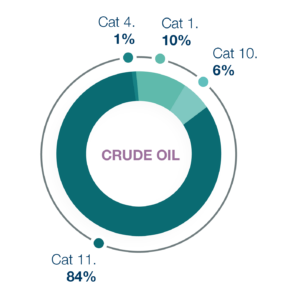
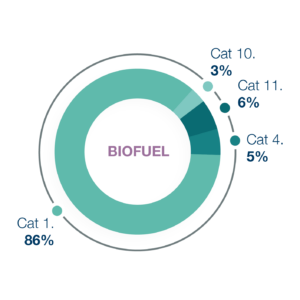
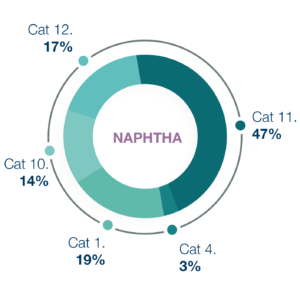
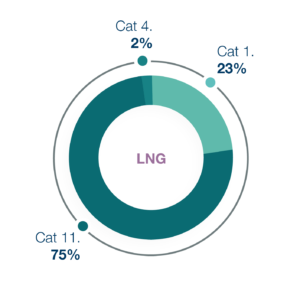
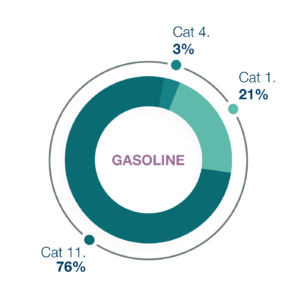
Category 1 Purchased goods and services – Emissions from the extraction and processing of raw materials embedded in the products traded by Gunvor. Represents 18% of total Scope 3 emissions across all traded products.
Category 4 Upstream transport and distribution – Emissions from third party logistics providers such as chartered vessels used to transport crude oil, refined products and other commodities from suppliers to storage terminals, refineries or trading hubs. In 2025, Gunvor is reporting emissions from time and voyage-charter vessels under Category 4. Represents 2% of total Scope 3 emissions across all traded products.
Category 6 Business Travel – Business travel covers greenhouse gas emissions arising from the transport of employees for business-related activities using vehicles not owned or controlled by the company. In 2025, Gunvor are only reporting emissions from flights.
Category 9 Downstream transportation and distribution – Covers emissions from the transport, storage and handling of products after Gunvor has sold them. This typically includes emissions from customer logistics chains such as shipping, pipelines, rail or trucking.
Category 10 Processing of sold products – This includes emissions where products including crude oil, unfinished petroleum products or other feedstocks are subsequently refined, upgraded or chemically processed by customers. These activities occur outside Gunvor’s control and represent 3% of total Scope 3 emissions across all traded products.
2025 Operational Emissions Footprint
| Operations | |||
|---|---|---|---|
| Sites* | Shipping | Travel (flights) | |
| Scope 1 | 1,134,748 | 68,167 | |
| Scope 2 | 6,853 | ||
| Scope 3 | 5,551,743 | 4,989,440 | 2,170 |
| 1. Purchased goods and services | 64,452 | ||
| 4. Upstream transportation and distribution | 4,989,440 | ||
| 6. Business Travel | 2,170 | ||
| 9. Downstream transportation and distribution | 72,878 | ||
| 10. Processing of sold products | |||
| 11. Use of sold products | 5,414,413 | ||
| 12. End of life treatment | |||
| *All Gunvor owned sites including new acquisitions, existing assets and trading offices | |||
Category 11 Use of Sold Products – Emissions generated by consumers from the combustion of energy commodities traded by Gunvor. This represents by far the largest share of emissions, at 76% of total Scope 3 emissions across all traded products.
Category 12 End-of-life treatment of sold products – Covers greenhouse gas emissions arising from the waste treatment and disposal
of products sold by Gunvor at the end of their lifecycle. This category represents a smaller share of total Scope 3 emissions in 2025, at 1%, and it is derived from petrochemical feedstocks used to create plastics and other materials.
Improving the reliability and completeness of CO2 emissions across Gunvor’s entire value chain remains a technically challenging process, and Gunvor continues to strive for improvements in data accuracy and robustness. The following table outlines Gunvor’s total value chain GHG emissions footprint in 2025.
Volume by product MMT
2025 Traded Product Emissions Footprint
| Scope 3 | Crude oil | Natural Gas* |
Biofuel | Naphtha | LNG | Gasoline | Gas oil | Fuel oil | LPG | Specialty Ores |
Base metals |
Jet fuel | Bitumen | Other |
|---|---|---|---|---|---|---|---|---|---|---|---|---|---|---|
|
1. Purchased goods and services
|
22,225,673 | 31,821,909 | 2,446,124 | 7,509,212 | 1,062,854 | 10,432,664 | 8,416,535 | 5,269,353 | 7,789,935 | 21,700,995 | 5,567,385 | 3,759,484 | 918,845 | 1,312,196 |
|
4. Upstream transportation and distribution
|
2,266,045 | 130,215 | 1,035,630 | 73,804 | 1,505,482 | 1,355,959 | 622,667 | 956,484 | 127,889 | 529,711 | 596,493 | 136,823 | 93,116 | |
|
9. Downstream transportation and distribution
|
830,975 | 13,839 | 139,116 | 151,086 | 127,760 | 83,318 | 86,119 | 54,193 | 13,129 | 2,830 | ||||
|
10. Processing of sold products
|
12,809,821 | 86,412 | 5,513,507 | 19,833 | 40,052 | |||||||||
|
11. Use of sold products
|
194,544,599 | 193,674,924 | 158,628 | 18,051,349 | 3,474,956 | 37,981,589 | 33,333,916 | 21,358,255 | 20,635,696 | 13,768,707 | 682,501 | |||
|
12. End of life treatment
|
6,383,563 | |||||||||||||
| Total Scope 3 Emissions | 232,677,113 | 225,496,832 | 2,835,218 | 38,632,377 | 4,631,446 | 50,070,820 | 43,234,169 | 27,333,593 | 29,468,234 | 21,828,884 | 6,097,097 | 18,178,877 | 1,108,850 | 2,090,644 |
GHG removals and GHG mitigation projects financed through carbon credits:
The Gunvor Carbon desk integrates financial investment, origination capabilities and trading expertise to identify and commercialise projects that deliver measurable reductions, avoidance and removal of carbon emissions. Working in close collaboration with leading project developers and corporate counterparties, Gunvor plays an active role in advancing high-quality carbon solutions across international markets. Its portfolio has been selectively developed to meet the requirements of key compliance frameworks, including the Carbon Offsetting and Reduction Scheme for International Aviation (CORSIA), Singapore carbon tax regulations and Article 6 mechanisms.
Gunvor actively expanded its involvement in voluntary carbon markets in 2025 through a variety of nature-based and community driven projects across Colombia, Gambia, Sierra Leone and Sri Lanka. Through several schemes, Gunvor has now financed circa 3.5m trees planted and participated in the distribution of circa 650,000 cookstoves to rural populations that previously relied on open wood fires. The Company also moved toward implementing a carbon credit offtake agreement with Genesis Fertilisers through signing a commercial Letter of Intent (LOI) as part of wider partnership encompassing natural gas and diesel exhaust fluid (DEF) supply.
CASE STUDY
DelAgua Sierra Leone – Empowering Women Through Clean Cooking in Sierra Leone
Gunvor is a partner in the development of the ‘Live Well’ project, which distributes fuel-efficient cookstoves to households across seven districts in Sierra Leone. By mid-2026, approximately 250,000 stoves had been distributed, each reducing wood consumption by 71% compared to traditional three-stone fires, thereby lowering greenhouse gas emissions and pressure on local forests.
Beyond these measurable climate benefits, the programme has significantly improved the daily lives of women, who previously spent hours collecting firewood and cooking on inefficient open fires. With reduced fuel needs and faster cooking times, women now spend less time on domestic labour, leading to improved health and greater overall wellbeing. The time saved has been reinvested into childcare, enabling better school attendance and academic support for children, while also supporting income-generating activities such as farming and small enterprises like soap-making.
In June 2026, Gunvor received the first issuance of credits from the project. These credits are eligible for the Carbon Offsetting and Reduction Scheme for International Aviation (CORSIA), further strengthening the credibility of the program through alignment with global regulatory standards.