Policies related to pollution:
Gunvor’s approach to pollution prevention is governed by its Group Health, Safety, Environment and Communities (HSEC) Policy. A formal, company-wide document that sets binding expectations across all business activities. The Environment section of this policy establishes clear principles for pollution prevention, emissions management, and environmental stewardship, reflecting our commitment to minimising the environmental footprint of our operations. The Group HSEC Policy is reviewed periodically to ensure alignment with evolving regulatory requirements and industry best practice.
E2-2Actions and resources in relation to
pollution:
Gunvor recognises that pollution risk is a material exposure inherent to commodity trading and processing operations. Our primary pollution risk pathways are transportation, including marine and inland waterway freight, and fixed operational sites where we hold operational control.
Transport Risk Management
Marine and barge transport presents the most acute spill and discharge risk in our value chain. We manage this through a structured suite of controls:
- Rigorous vessel and barge vetting protocols aligned with industry standards (e.g., SIRE, CDI)
- Strict adherence to applicable transport safety and environmental regulations, including MARPOL
- Pre-arranged emergency response frameworks to ensure rapid containment and remediation in the event of an incident
Operational Sites
At sites where Gunvor holds operational control, pollution risk is managed through environmental permit compliance under applicable national and EU regulatory frameworks. In Europe, the Industrial Emissions Directive (IED) is the primary regulatory instrument governing our refining, combustion, and chemical processing activities. Our sites operate under detailed environmental permits that incorporate sector-specific Emission Limit Values (ELVs) derived from Best Available Techniques (BAT) conclusions covering emissions to air, water, and land.
Each operational site maintains a dedicated Health, Safety and Environment (HSE) function responsible for:
- Executing continuous environmental monitoring programmes in line with permit conditions
- Implementing environmental improvement obligations and capital upgrade programmes
- Managing incident response, regulatory notifications, and corrective action tracking
Group-Level Oversight
Regulatory environmental compliance is embedded as one of Gunvor’s 13 HSEC Standards, which carries specific requirements for pollution prevention and environmental protection. Compliance is monitored through structured internal reporting and a formal audit programme, with findings escalated to senior management where material risks are identified.
Targets related to pollution:
Gunvor does not currently operate under fixed quantitative pollution reduction targets. Instead, pollution performance is managed through a structured accountability framework embedded within its Group HSEC governance model, with continuous improvement as a guiding principle. Performance is tracked through ongoing environmental monitoring programmes, with results reported internally and to the relevant regulatory authorities as required.
2025 Performance Overview
- Maintain low level of environmental exceedances
As can be seen in the graph below, the number of environmental exceedances was slightly higher than in the previous year. This is related predominantly to the shutdown of the activities over at GER and the installation of new wells at GRI.
- Maintain low level of community complaints
As the graph depicts, community complaints have decreased year-on-year. This reflects the proactive culture that prevails at Gunvor assets.
- Maintain spill prevention performance
- In 2025, there were no spills larger than a barrel showcasing an improvement from last year.
- Systematize reporting of recyclable waste with a view improving recyclability
See section on waste.
- Continue to develop plans for biodiversity preservation measures on operated assets
See section on biodiversity.
2026 Objectives
- Maintain a low level of exceedances and complaints
- Maintain spill prevention performance
Gunvor’s management rigorously maintains operational compliance, promptly addressing and investigating regulatory breaches to prevent future occurrences. In 2025, whilst there was decrease in community complaints, there was a slightly increase in exceedances compared to 2024 as illustrated in the graph. The assets exceedances mainly involve short-term air emissions, with some exceedances related to wastewater. Examples include brief SO2 emission exceedances as a result of operating mode changes and analyse issues. No environmental fines were levied against any Gunvor asset during 2025, reflecting both the group’s commitment to proactive regulatory engagement and the effectiveness of its site-level HSE management systems. Where community concerns regarding operational impacts were raised, these were addressed through direct engagement with local stakeholders in a transparent and timely manner.
| 2022 | 2023 | 2024 | 2025 | |
|---|---|---|---|---|
| Environmental exceedances | 8 | 10 | 9 | 13 |
| Community complaints | 8 | 14 | 9 | 7 |
Pollution or air, water and soil:
Air Emissions
Gunvor’s industrial sites operate under comprehensive air emission monitoring programmes, with pollutant levels measured, recorded, and reported to the relevant regulatory authorities in accordance with applicable permit conditions. Monitoring is conducted on a periodic basis depending on the pollutant and regulatory requirement; where measured concentrations exceed permitted thresholds, these are recorded and reported as exceedances in line with our HSEC compliance obligations.
The most material air pollutants across Gunvor’s production sites are Sulphur Dioxide (SO2), Nitrogen Oxides (NOx), Particulate Matter, and Volatile Organic Compounds (VOCs). Each is managed through a combination of engineering controls, operational practice, and permit-driven monitoring.
NOx is generated primarily in furnaces and gas turbines, where nitrogen in combustion air reacts with oxygen under high-temperature conditions. Gunvor has retrofitted a significant proportion of its furnace fleet with low-NOx burner technology to reduce formation at source.
VOCs are controlled through a layered abatement approach, including vapour recovery systems, floating roof tank equipment, and systematic Leak Detection and Repair (LDAR) programmes across operational sites.
SO2 originates principally from sulphur content in process fuels and from catalyst regeneration in the Fluid Catalytic Cracking (FCC) unit at Gunvor’s German refinery (GRI) in Ingolstadt. Gunvor has materially reduced SO2 emissions over time through fuel switching, most notably the transition from oil to natural gas, which has also delivered co-benefits in particulate emission reduction. Since 2023 a step-change reduction was achieved, with the installation of a dedicated SO2 scrubber on the FCC unit at GRI.
2025 Performance
The air emission data presented in the table below covers Gunvor’s refining sites and the BBE power plant, acquired in 2024. Two site-specific factors are relevant to the year-on-year comparison:
- GRI (Refinery): Emissions in 2025 reflect lower throughput activity relative to 2024
- GER (Refinery): Emissions are lower in 2025 due to the halt in production activity
- BBE (Power Plant): Emissions from this asset are closely correlated with electricity generation output, which is highly variable in nature, and should be interpreted in that context
GUNVOR AIR POLLUTION TABLE
| 2022 | 2023 | 2024 | 2025 | |||||||||
|---|---|---|---|---|---|---|---|---|---|---|---|---|
| GER | GRI | BBE | GER | GRI | BBE | GER | GRI | BBE | GER | GRI | BBE | |
| SO2 (t) | 132 | 2,502 | 5 | 98 | 1,833 | 2 | 65 | 2,184 | 3 | 916.3 | 3.3 | |
| NOx (t) | 208 | 535 | 282 | 189 | 423 | 129 | 157 | 497 | 196 | 526.3 | 167.3 | |
| VOC (t) | 235 | 475 | 59 | 212 | 455 | 31 | 214 | 460 | 39 | 419.9 | 31.6 | |
| Dust (t) | 1.6 | 6.9 | 13 | 1.4 | 5 | 7 | 2.7 | 8 | 9 | 3.6 | 7.1 | |
Water Emissions
All of Gunvor’s production sites operate dedicated wastewater treatment plants, functioning under regulatory permit conditions that specify monitoring requirements, contaminant parameters, and emission limit values (ELVs). Monitoring is carried out on a daily, weekly, or monthly basis depending on the substance type and applicable regulatory framework.
Given that contaminant profiles, monitoring frequencies, and ELVs vary materially between sites, aggregate totals are not a meaningful basis for performance assessment. Gunvor therefore reports the number of ELV exceedances as its primary wastewater compliance metric, a more relevant indicator of environmental management effectiveness across a diverse asset base.
Soil pollution
Soil contamination at Gunvor’s operational sites is primarily associated with losses of containment, leaks and spills arising from process equipment, pipework, and transfer operations. All such events are required to be reported through Gunvor’s internal incident management system, triggering assessment of appropriate response and preventive measures.
Spill performance is tracked as a monthly indicator across production sites, reported against two size thresholds: below one barrel (159 litres) and at or above one barrel. This tiered reporting approach allows management to monitor both significant release events and the broader frequency of minor losses of containment.
In 2025, there were no spills exceeding the one-barrel threshold that has been recorded at Gunvor’s production sites. In the event of a spill, regardless of volume, a procedure is followed by clean-up or remediation works as a standard requirement, with root cause findings used to inform operational improvements and prevent recurrence.
Substances of concern and
substances of very high concern:
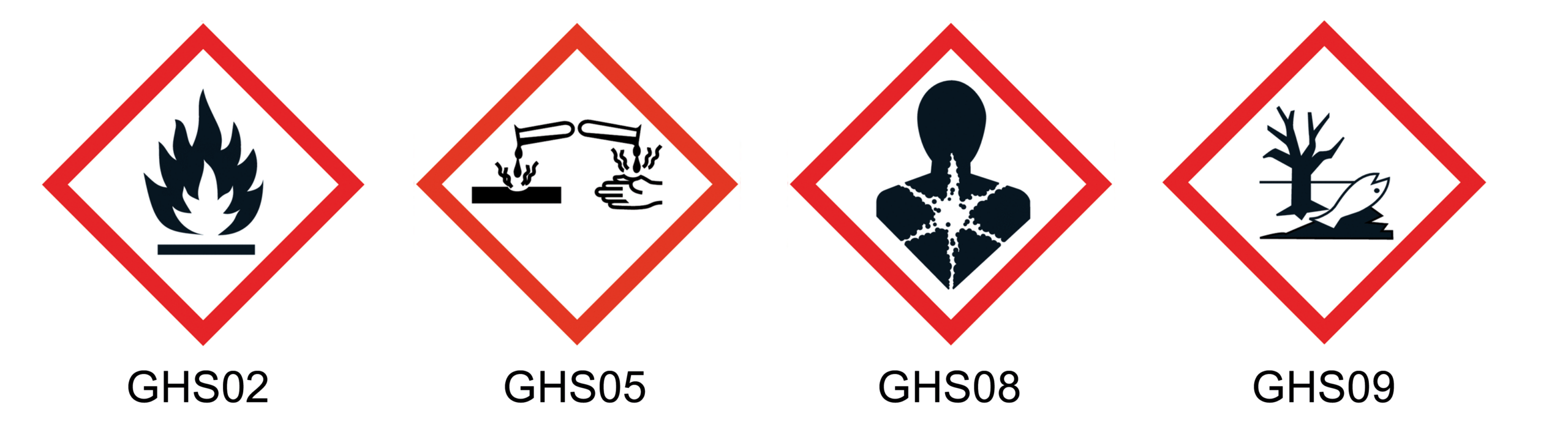
Substances of Concern (SC) are considered those substances that meet the following classifications according to the European CLP Regulation (which implements the globally harmonized system of the United Nations for the classification and labelling of chemicals):
- Carcinogenicity category 1 and 2
- Mutagenicity category 1 and 2
- Reproductive toxicity category 1 and 2
- Endocrine Disruptive
The following classification according to the European Registration, Evaluation, Authorisation and Restriction of Chemicals (REACH) regulation:
- Persistent, Bioaccumulative and Toxic (or very persistent and very bioaccumulative)Mutagenicity category 1 and 2Reproductive toxicity category 1 and 2Endocrine Disruptive
Gunvor trades many petroleum products, and the following fuels meet the criteria listed above with respect to Carcinogenicity (Carc.), Mutagenicity (Muta.) or Reprotoxicity (Repr.):
- Gasoline (Carcinogenicity cat. 1B, Mutagenicity cat. 1B, Reprotoxicity cat. 2)
- Gasoil, diesel (Carcinogenicity cat. 2)
- Fuel oil (Carcinogenicity cat. 1B, Reprotoxicity cat. 2)
(Category 1B stands for presumed, category 2 for suspected)
In addition, feedstocks such as crude oil and naphtha and certain refinery intermediate streams also meet the criteria listed above.
For an impression of the quantities of the traded Substances of Concern we refer to information in the business sections of the annual report.
It should be kept in mind that a classification like presumed carcinogen does not mean that the substance poses a risk during normal use. The classification is based on intrinsic hazardous properties as determined with e.g. animal testing and not on risk assessment. Risk Management Measures are designed and prescribed to keep the exposure within acceptable limits. For example, the gasoline we sell is to be used as fuel. During such use, there is no exposure to the substance that could result in a relevant risk. The allowed uses and the appropriate risk management measures are communicated to
clients by means of Safety Data Sheets. Currently none of Gunvor’s products are classified as Endocrine Disruptive or as Persistent, Bioaccumulative and Toxic.
SUBSTANCES OF VERY HIGH CONCERN
Substances of Very High Concern Substances of Very High Concern (SVHC) are considered those substances that are included in Annex XIV of the REACH regulation (substances subject to authorization) or substances on the candidate list for inclusion in that annex, published and regularly updated by the European Chemicals Agency. Gunvor does not trade such substances. However, some of the products we trade may contain SVHC as constituents in low concentrations. In particular, heavier oil products such as fuel oil contain Polycyclic Aromatic Hydrocarbons (PAH). This group consists of thousands of different constituents and some of them are on the SVHC list. Under normal use as fuel, this presence does not result in significantly elevated environmental or health risks if the appropriate risk management measures are applied.